Welcome to the Big6

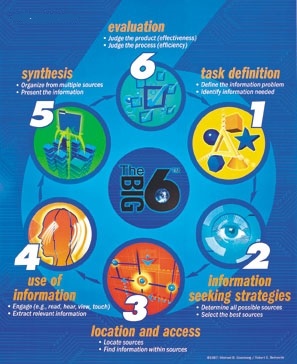
You can do BIG things with Big6 Skills! Big6 is a six-stage model to help anyone solve problems or make decisions by using information. Some call it information literacy, information communication, or ICT skills, or a process, but we call it the Big6.

Using the Big6 information literacy process, you will identify information research goals, seek, use, and assemble relevant, credible information, then to reflect— is the final product effective and was my process efficient. The Big6 information literacy process is completely transferable to any grade level, subject area, or workplace. Big6, state and national instructional standards, and your curriculum all work together hand-in-hand.


High School Diploma Online
Lacking a high school diploma or GED certification? Free educational materials in the subjects of writing and grammar which allow you to earn your high school diploma online.


News Feed

Handouts for Texas Library Association Presentations
Read More
Latest from Project Information Literacy -

Please check out this infograph - 

http://ajhead1.wordpress.com/about/

It's reference in this paper being presented at ACRL - http://conference.acrl.org/invited-papers-pages-265.php


For Teacher-Librarians Regarding BYOT - Bring Your Own Technology


Hi All - 

I just posted this message to LM_NET, the community for teacher-librarians. I thought I'd share it here as well:


Greetings LM_Netters! 

It's been a while since I've posted, but I do continue to lurk.  But - I HAD to post about this development and opportunity.

The school library field continues to experience a slow and painful decline in many states and communities. I won't go into the reasons, rather let's focus on some solutions.

http://www.nytimes.com/2013/03/23/technology/in-some-schools-students-bring-their-own-technology.html?pagewanted=all

Read More
The Big6 and the Common Core - recording of free webinar -

The Big6 and the Common Core

FREE BIG6 WEBINAR - by Mike Eisenberg and Bob Berkowitz - orginally held TUESDAY - March 12 - The Big6 and the Common Core

http://www.instantpresenter.com/edwebnet/EA53D681814E


The Future?

Interesting graphic look at what the future might hold - Tomorrow’s world: A guide to the next 150 years. (2013, January 2). BBC. Retrieved from http://www.bbc.com/future/story/20130102-tomorrows-world 

Documents That Changed the World

Terrific Series by my good friend and colleague at the University of Washington iSchool, Joe Janes -http://www.washington.edu/news/2012/12/11/documents-that-changed-the-world-roberts-rules-of-order/

Podcasts definitely worth checking out!

Job Skills - Not all Digital! Update from Project Information Literacy

Alison Head, Affiliate Associate Professor at the UW iSchool and PI of Project Information Literacy, wrote an excellent Op-ed in the Seattle Times today - "Old-school job skills you won't find on Google"

http://seattletimes.com/html/opinion/2019857185_alisonheadopedxml.html

Summary: Young graduates might well be digital savvy, but employers are finding they lack the old-school research skills. Guest columnist Alison J. Head proposes some ways to bring them up to speed.

Read More
Mike and Bob Discuss: The Big6 and the Common Core

Bob and I have been talking offline about the Common Core, the information literacy/Big6 connections, and the impact on education K-12.  We thought we'd share our interactions more broadly by posting here on the Big6 website:    Link to Discussion

For background, here are some other  links:

  Common Core home page - 
  http://www.corestandards.org/ 

  Common Core State Standards - 
  http://www.corestandards.org/assets/CCSSI_ELA%20Standards.pdf

Please contribute to the discussion by adding your comments or questions:   Link to Discussion


Using the Big6 - How to Get Started in the Classroom

NOTE: This message was sent to info(at)big6(dot)com. Marie graciously gave permission to share the question and response with everyone.

My name is Marie Willingham and I am currently enrolled at Sam Houston State University in their Library Science Master's program. I am a third grade teacher to 43 amazing creatures of the future. I have simple question for you that might have a more complex answer. From your research with the Information Literacy Project and Big 6, how should a teacher begin teaching information literacy and what are the essentials that a modern day, 21st century student should know?

Thank you for your passion for students and literacy. Thank you for embracing the future. Thank you for giving teachers hope in the "experts" who often seem out of touch with the youth of today.

Sincerely,
Marie Willingham


Response from Mike Eisenberg: 

Marie – Thanks so much for emailing and also for giving permission to post your question. First, in terms of how to begin – “just do it.”  That is, starting right away, we recommend using the Big6 (or Super3 for the very young) terminology when you are talking to students, teaching, or mentoring one-on-one.

[Click here for the full response - and an opportunity to post your comments]

Read More
Learning Curve: How College Graduates Solve Information Problems Once They Join the Workplace!


Excellent report from Project Information Literacy - by Alison Head - about the transition from college to work. Based on interviews with 23 employers and 33 recent grads.  Abstract below - key findings here:

Graduates said they found it difficult to solve information problems in the workplace, where unlike college, a sense of urgency pervaded and where personal contacts often reaped more useful results than online searches. 

Graduates said they leveraged essential information competencies from college for extracting content and also developed adaptive information-seeking strategies for reaching out to trusted colleagues in order to compensate for what they lacked.
 
Employers said they recruited graduates, in part, for their online searching skills but still expected and needed more traditional research competencies, such as thumbing through bound reports, picking up the telephone, and interpreting research results with team members. They found that their college hires rarely demonstrated these competencies.
 
Findings suggest there is a distinct difference between today’s graduates who demonstrated how quickly they found answers online and seasoned employers who needed college hires to use a combination of online and traditional methods to conduct comprehensive research.
 
For full study, please see:  
 
For more on Project Information Literacy see: http://projectinfolit.org
Read More
Big6 by the Month - 2012/2013 - kicked off on AUGUST 23rd!

The 2012/2013 Big6 by the Month Webinar Series started on August 23rd. But - it's not too late to join in!

Big6 by the Month is our proven approach to a comprehensive and systematic information & technology skills instructional program.  In this webinar series, we work with you each month to plan and deliver a defined, predictable, measured, and reported information and technology literacy curriculum. 

If you missed the first webinar - it's okay! We record each one and make them available to all attendees. And, the "early bird" registration price is still good through the end of August - $113 for the entire series of 9 webinars. If you have any questions, please email us at mailto:info(at)big6(dot)com

The next webinar is scheduled for Sept 6, Thursday, at 7pm EDT, 4pm PDT. The topic is Task Definition. From research and experience, we know that Task Definition is one of the most important and difficult information problem-solving skills. Students report (in Project Information Literacy) that they have the most problems with just starting an assignment or task.  WE CAN HELP - with effective Big6 and Super3 lessons in the context of classroom-based assignments. This webinar will cover all the details!


The instructors for Big6 by the Month are Mike Eisenberg, Janet Murray, and Colet Bartow with support from Sue Wurster.

This is our #1 series for educators interested in developing and implementing an information and technology literacy program. Our approach is systematic and practical. Attendees gain mastery of the Big6 and Super3 information and technology skills processes AND direct experience with setting a Big6/Super3 program, linking to school, district, state, and national standards, and planning for classroom, library, or technology lab lessons and units. EVERY attendee will be able to immediately implement Big6 and Super3 instruction and establish an information and technology literacy program that is

  • defined
  • predictable
  • measured 
  • reported. 

There are 9 one-hour webinars in the series:

August 23, 2012 - Overview
Sept 6, 2012 - Task Definition
Oct 18, 2012 - Info Seeking Strategies
Nov 15, 2012 - Location & Access
Dec 6, 2012 - Use of Info
Jan 10, 2013 - Revisit and Reflect
Feb 7, 2013 - Synthesis
Mar 7, 2013 - Evaluation
April 4, 2013 - Culminating Activities
 
Each is recorded (and available to you at no additional charge) in case you miss a session or want to revisit the content. There is also a 40+ page PDF handout packet for EACH webinar session.
 
We work hard to keep the costs down - only $14.95 per event per person. A "season pass" for all 9 is $134.00.  And, there's an EARLY BIRD DISCOUNT through the month of August - $113.00 for the entire series.
 
For registration or more information, please go to:  Big6 by the Month or http://bit.ly/Big6byMonth or email questions to info(at)big6(dot)com
 
 
Read More
Kentucky Virtual Library - Big6-based "How To Do Research" game

Check out this excellent (and fun) research game and overview from the Kentucky Virtual Library. It's Big6-based, of course.l

http://www.kyvl.org/kids/homebase.html

Mosaic of Thought and the Big6

I'm learning about Keene and Zimmerman's "Mosaic of Thought" reading comprehension approach. It looks excellent and very compatible with the Big6.

Has anyone used this with the Super3 or Big6?  (I also posted this on the Big6 Facebook page - http://www.facebook.com/big6skills

Mosaic of Thought is clearly compatible to Big6, directly connected to Big6 #4 - Use of Information: 4.1 Engage, 4.2 Extract.  It also links Use of Informaiton to Task Definition.  I think the Big6 can help students to use the Mosaic of Thought comprehension strategies and tactics in a problem-solving context.

Many teachers use Mosaic of Thought in a mini-lessons approach - 

15 min - mini-lesson modeling a strategy

15 min - meet with small groups for extra guidance and practice.

15 min - one-on-one work with students 

15 min - full class summary and discussion.

I think it would be useful to frame the mini-lesson and specific comprehension strategy in a Big6 context. That is, if students learn the Big6 process, they can relate the comprehension strategy to Big6 #4.1 or 4.2 (or even Task Definition 1.1, if relevant).  They can also assess their degree of expertise in comprehension and the specific strategy under Big6 # 6.2 - Evaluation: Judge the Process.

Again - please share your experiences with Mosaic of Thought or other relevant instructional models.


Read More
New lesson posted - How to Get an "A"

Check it Out - new lesson for Big6 #1.1 (and 6.1)

http://big6.com/pages/lessons/lessons/how-to-get-an-a.php

We are pleased to post this valuable lesson for upper elementary as well as middle schools. 

The lessons is from a packet of excellent materials shared with the Big6 team by Melanie Bonanza from the Hyde Park (NY) Schools.

We plan to post additional lessons and content from Melanie and her colleagues in the future.  A Big6 thanks to Melanie for bringing these to our attention and giving permission to share.

Read More
Google Search Education - Lesson Plans

Hi All -

I just posted a similar messge on the Big6 Facebook page - 

 
I recently came across Google's "search education" materials -
 
There are lesson plans focused on 2 Big6 stages - #3 - Location & Access and #4 - Use of Information.  They seem impressive, but has anyone used them? How have students reacted?  
 
Thanks,
 
Mike
Information Alchemy

Information Alchemy: Transforming Data and Information into Knowledge and Wisdom

March 30, 2012

Mike Eisenberg

Dean Emeritus and Professor
The Information School of the University of Washington

One of the key conceptual models of the information field is the "information spectrum," the hierarchy of data - information - knowledge - wisdom.

I first learned this model from Bob Taylor, former dean of the Syracuse University School of Information Studies, and it is explained in his book, Value-Added Processes in Information Systems, Ablex, 1986, as the "Value-Added Spectrum," (p. 6). 

I teach this model to almost all of my classes, especially to my undergraduate students as part of developing an "information perspective" -- looking at the world through information-colored glasses. 

This is the way I explain the information spectrum (sometimes referred to as the DIKW hierarchy):

  • Data = characters, symbols, numbers, signs whose meaning may or may not be apparent.
  • Information = data with labels or definition; data that has structure or relationships.
  • Knowledge = collected, combined, organized, processed information for a purpose. 
  • Wisdom = knowledge over time; knowledge without thinking. 
Read More
Blast from the Past - Bob Berkowitz introduces the stages of the Big6 process

We recently uncovered this short, 1 minute video of a "young" Bob Berkowitz explaining the Big6 to Danny Callison from Indiana University. This clip has been used in courses at IU and IUPUI for years!  Still highly relevant!


http://www.indiana.edu/~video/stream/launchflash.html?folder=slisal&filename=nquir03.m4v

Read More
Citing - for the Very Young (Super3 style)

Crediting and citing - let's make it positive, easy, and fun, not punative, hard and a chore.

I've been thinking a lot about developing citing/creditng skills among elementary students.

This can and should be fun - creating a "culture of crediting" in a school with classroom teachers, teacher-librarians, technology teachers, administrators and even parents modeling for students by continually crediting and citing sources - in coversation, teaching, on paper, and electronically.


====>>>>

Read More
Information Abundance

Musings from Mike Eisenberg - 

I'm preparing a number of presentations for different audiences about information and technology literacy and information problem-solving. In order to "set the scene" I like to talk about what it's like to live in our information society - in a world where there is an abundance of information, not scarcity.

This wasn't always the case.  Even 30-40 years ago, it was a challenge to find and gather relevant and credible information. We aren't that far removed from the times when you had to make an appointment with a professional librarian if you wanted to conduct an online search. Access was so limited and costly, that the librarian would conduct a pre-search interview and then do the search for you - sometimes not even with you present! Again, those were the days when the challenge was finding, search, and gathering.

Read More
Big6 Amazon Store - up and running!

The new Big6 store is up and running!  - http://big6-store.hostedbyamazon.com/


To celebrate, we are holding a Spring Sale of the blackline masters - for Super3 and Big6.


Also, due to extra inventory, we are offering the Super3 Project Instruction DVD (normally $89.95) at 50% off = $44.98.


This is a ready-to-go kit for classroom teachers and teacher-librarians to implement projects aimed at very young students (pre-K through grade 2). The kit includes templates, PowerPoint slides, teacher, and student training materials.  

Super3 Project Instruction DVD

---------------------------

We will be adding more resources to the store in the near future. Please contact sales(at)big6(dot)com if there is something missing that you would like us to include.

Read More